
As a parent, educator, and sports coach I know the importance that motivation plays in moving young people to action, and nowhere is this more true than in the realm of exercise and sports. Previous research has shown youth to involve themselves in sports and other types of regular physical activity for a number of reasons, the most important appearing to be for fun and enjoyment. Theoretical research in the field of motivation has delineated two types of motivational sources: internal and external. Intrinsic motivation originates from within a person. Since intrinsic motivation has an internal source, it is hypothesized to be a stronger form of motivation, leading to more long-lived activity. Examples of intrinsic motivation include participating in an activity because the activity is inherently interesting or because it brings about fun or enjoyment. Conversely, extrinsic motivation involves an action performed for the purpose of attaining some separate external outcome such as wanting to please someone, gain recognition, or win a prize. Since extrinsic motivation has an external source, it is hypothesized to be a weaker form of motivation that may limit longevity in an activity. In addition, extrinsic motivation can be further described as being more or less internal/external depending on its source. The most external form of extrinsic motivation is based on sources outside an activity such as the desire to be physically attractive to self or others, be awarded a trophy, or avoid some type of punishment. Other types of extrinsic motives that have varying degrees of internal or external forces at work include participation in an activity because of the benefits that the activity brings (somewhat internal) and involvement in an activity out of the guilt or pressure brought on by oneself or others (somewhat external).
As part of a recently completed doctoral dissertation, I studied middle and high school modified independent study students on five specific motives for participation in sports and physical activity. Included were intrinsic motives (interest/enjoyment and competence), more internalized extrinsic motives (fitness and social) and a highly extrinsic motive (appearance). Mean importance ratings of the motives were compared for the participant sample as a whole. In addition, mean scores of the different motives were analyzed according to grade level (middle school vs. high school), gender (male vs. female), and physical activity type (organized sports vs. not in organized sports). What follows is a brief review of my dissertation research project.
THE PARTICIPANTS
A total of 383 modified independent study middle and high school charter school students took part in the study. By definition, modified independent students attend an on-site academic program that meets one to four days each week, spending the off-site days working on assignments from home or some other place of study. Of the total participant sample, 207 were middle school students, 201 were male, and 196 participated in organized sports.
THE INSTRUMENT
The Motives for Physical Activity Measure-Revised (MPAM-R) included 30 items which measured the importance of interest/enjoyment, competence, fitness, social, and appearance in relation to physical activity participation on a scale from 1 to 7, with 1 meaning “not at all true for me” and 7 meaning “very true for me.”
DESIGN
A quantitative, correlational research design was used in this study. Descriptive and inferential statistics were run in order to determine the overall importance of the motives for the sample population as a whole along with significant differences in the motives between grade level, gender, and physical activity type groups.
FINDINGS & DISCUSSION
Overall Importance Ratings. The motives rated from highest to lowest by the total participant population were:
- Fitness (Mean Score = 5.511)
- Interest/Enjoyment (Mean Score = 5.261)
- Competence (Mean Score = 5.229)
- Appearance (Mean Score = 4.072)
- Social (Mean Score = 3.826)
It’s interesting to note that the mean scores for fitness, interest/excitement, and competence gravitated toward the higher end of the scale while appearance and social leaned toward the middle of the scale. Since more internal motives are typically rated higher than external motives for populations as a whole, as is noted by the research literature, these findings were somewhat expected. In particular, since interest/enjoyment and competence are intrinsic and fitness is extrinsic but somewhat internal, these motives would be expected to be rated higher than appearance, which is highly extrinsic. Interestingly, the low rating of the extrinsic but somewhat internal social motive was unexpected as a plethora of research has found that youth participate in physical activity, in part, because they enjoy their interaction with others.
Middle School Importance Ratings. The motives rated from highest to lowest by the middle school group were:
- Interest/Enjoyment (Mean Score = 5.424)
- Fitness (Mean Score = 5.396)
- Competence (Mean Score = 5.293)
- Social (Mean Score = 3.860)
- Appearance (Mean Score = 3.574)
 The mean score findings for middle school group were somewhat similar to findings of the total population as the top three motives (interest/enjoyment, fitness, and competence) were rated at the higher end of the scale, while the remaining two motives (social and appearance) were rated in the middle of the scale. For this group, the intrinsic interest/enjoyment and competence motives were rated first and third respectively, the extrinsic but somewhat internal motives of fitness and social were rated second and fourth respectively, and the highly extrinsic motive of appearance was rated last.
High School Importance Ratings. The motives rated from highest to lowest by the high school group were:
- Fitness (Mean Score = 5.626)
- Competence (Mean Score = 5.164)
- Interest/Enjoyment (Mean Score = 5.099)
- Appearance (Mean Score = 4.570)
- Social (Mean Score = 3.791)
The mean score findings for high school group showed motives in four distinct places on the 1-7 scale. The top-rated extrinsic but somewhat internal motive of fitness placed well ahead of the two intrinsic motives of competence and interest/enjoyment. In addition, the fourth rated highly extrinsic motive of appearance placed well below competence and interest/enjoyment, but well ahead of the extrinsic but somewhat internal social motive.
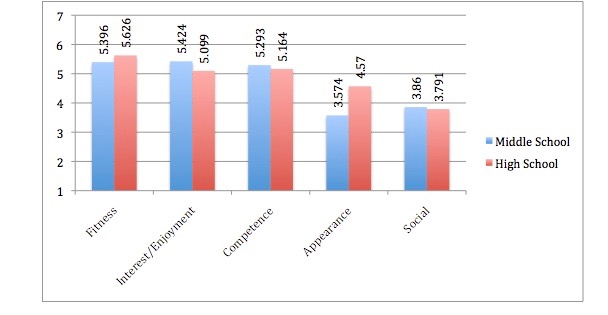
Grade Level Comparison. When comparing mean scores by grade level, the middle school group rated interest/enjoyment, competence, and social higher than the high school group while the high school group rated fitness and appearance higher than the middle school group (See Figure 1). A statistically significant difference was reached only on the interest/enjoyment (middle school over high school) and appearance (high school over middle school) motives. Once again, these findings are not surprising as younger children have been known to participate in activities for intrinsic motives such as wanting to have fun, develop skills, and be with friends. Motives such as fitness appear to become more important as youth age and understand more the components of fitness and how it can impact one’s life. In addition, the finding that the older high school youth prioritized appearance motives would seem logical as this is the age when youth are developing boyfriend-girlfriend relationships, and looking physically attractive has much to do with that.
Figure 1
Mean Importance Ratings of the MPAM-R: Grade Level Comparison
Male Importance Ratings. The motives rated from highest to lowest by the male group were:
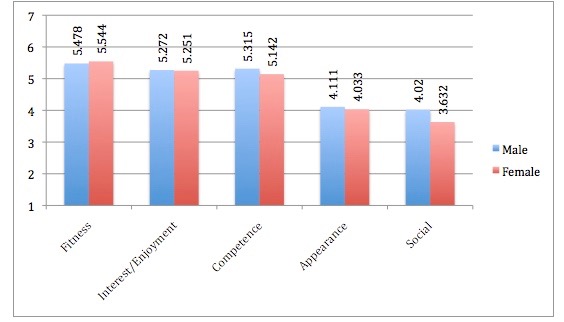
- Fitness (Mean Score = 5.478)
- Competence (Mean Score = 5.315)
- Interest/Enjoyment (Mean Score = 5.272)
- Appearance (Mean Score = 4.111)
- Social (Mean Score = 4.020)
When comparing mean importance scores for the male group, the scores were similar to the high school group’s importance ratings with the extrinsic but somewhat internal motive of fitness rated the highest, followed closely by the intrinsic competence and interest/enjoyment motives. Well behind were the highly extrinsic and the extrinsic but somewhat internal appearance and social motives.
Female Importance Ratings. The motives rated from highest to lowest by the female group were:
- Fitness (Mean Score = 5.544)
- Interest/Enjoyment (Mean Score = 5.251)
- Competence (Mean Score = 5.142)
- Appearance (Mean Score = 4.033)
- Social (Mean Score = 3.632)
Mean importance scores for the female group were similar to the scores for the overall population as the top three motives of fitness (extrinsic but somewhat internal), interest/enjoyment (intrinsic), and competence (intrinsic) were clustered on the higher end of the scale while the appearance (highly extrinsic) and social (extrinsic but somewhat internal) motives were ranked in the middle of the scale.
Gender Comparison. When comparing scores by gender, the male group rated interest/enjoyment, competence, appearance, and social higher than the female group while the female group rated fitness higher than male group (See Figure 2). A statistically significant difference was reached only on the social motive (males over females), which was surprising given the fact that females have been known to highly prioritize social factors for their participation in various activities including sports and physical activity. Further study is needed to better understand why the males in this investigation rated the social motive higher than the females. For all other motives, the differences were so close and were considered statistically insignificant.
Figure 2
Mean Importance Ratings of the MPAM-R: Gender Comparison
Organized Sports Importance Ratings. The motives rated from highest to lowest by the organized sports group were:
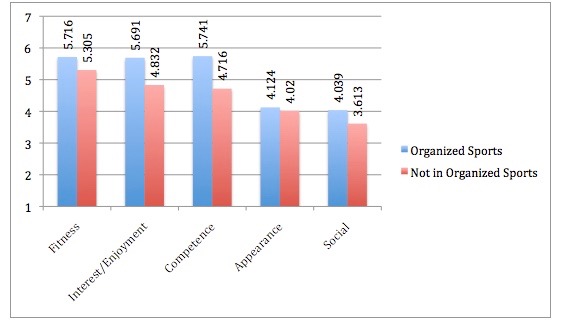
- Competence (Mean Score = 5.741)
- Fitness (Mean Score = 5.716)
- Interest/Enjoyment (Mean Score = 5.691)
- Appearance (Mean Score = 4.124)
- Social (Mean Score = 4.039)
 The mean importance scores for organized sports group showed that the intrinsic motive of competence was rated first, followed very closely by the extrinsic but somewhat internal fitness and intrinsic interest/enjoyment movies. Far behind were the highly extrinsic appearance and extrinsic but somewhat internal social motives.
Not In Organized Sports Importance Ratings. The motives rated from highest to lowest by the not in organized sports group were:
- Fitness (Mean Score = 5.305)
- Interest/Enjoyment (Mean Score = 4.832)
- Competence (Mean Score = 4.716)
- Appearance (Mean Score = 4.020)
- Social (Mean Score = 3.613)
Mean importance scores for the not in organized sports group were similar to the scores for the overall population and female group as the top three motives of fitness (extrinsic but somewhat internal), interest/enjoyment (intrinsic), and competence (intrinsic) were grouped on the higher end of the scale while the appearance (highly extrinsic) and social (extrinsic but somewhat internal) motives were ranked in the middle of the scale.
Physical Activity Type Comparison. When comparing scores by physical activity type, the organized sports group rated all motives higher than the not in organized sports group (See Figure 3). A statistically significant difference was reached on all but the appearance motive. These findings appear to suggest that those involved in organized sports are motivated to involve themselves in their particular “physical activities” to a higher degree for all tested variables (motives) as compared to those who did not participate in organized sports. When evaluating each of the motives, these findings should not be surprising. For example, fitness and competence go hand in hand when participating in competitive athletics. The more that one grows in fitness and competence with regard to their particular sports skill set, the more proficient and successful they will become. In addition, organized sports requires a dedication that goes above and beyond. In order to persevere in this dedication, logic would dictate that he or she should find their activity interesting and enjoyable. In addition, although the appearance motive was not significantly different, organized sports participants are in the spotlight as they perform in front of others. Wanting to show off a good or athletic physical appearance on the playing field may be important not only for those in the bleachers but also their opponents. Finally, both individual and team sports are played in the context of others. Consequently, organized sports participants often participate for reasons related to social reasons.
Figure 3
Mean Importance Ratings of the MPAM-R: Physical Activity Type Comparison
SUMMARY & IMPLICATIONS
For the total population and all three subgroups, the top three rated motives for participating in sports and physical activity (in slightly different orders) included two intrinsic motives (interest/enjoyment and competence) and one extrinsic but somewhat internal motive (fitness). The least important motives by score and rank were the highly extrinsic and the extrinsic but somewhat internal appearance and social motives. Interestingly, the social motive was rated the least important by all but the middle school group, which rated it ahead of appearance but well behind the interest/enjoyment, fitness, and competence motives. Overall, it appears that the scores of this population are consistent with those of other populations as the intrinsic interest/enjoyment and competence motives and extrinsic but somewhat internal motive of fitness were rated high and the highly extrinsic motive of appearance was rated low. The one exception was the social motive which was consistently rated very low by the population as a whole and the different grade level, gender, and physical activity groups. One explanation for this anomaly may be that the students attracted by the modified independent study charter school are inherently more self-regulated and are not as reliant on relatedness issues for their participation in different activities such as sports or physical activity.
When evaluating differences between the grade level groups, a statistically significant difference was reached on the interest/enjoyment (middle school over high school) and appearance (high school over middle school) motives. Research has found that younger youth regularly participate in activities out of the sheer enjoyment they experience. As youth age, more extrinsic motives appear to become more important, such as wanting to look attractive so to impress others. Gender comparisons revealed a surprising finding as the male group scored significantly higher on the social motive than the female group. Prior research has found that females highly value social factors for their participation in various activities including sports and physical activity. Further study is needed to better understand why the males in this study rated the social motive higher than the females. Finally, the differences were most pronounced between the two physical activity groups (organized sports vs. not in organized sports), as a statistically significant difference was reached on all but the appearance motive. In other words, organized sports participants appear to be attracted to their physical activity to a higher degree than those not involved in organized sports for the following motives: interest/enjoyment, competence, fitness, and social.
CONCLUSION
Knowing what motives are important to youth can be helpful in planning all types of physical education, sports, and recreation programs. In the case of this population as a whole, it would be advised that physical education and sports programs focus on fitness, fun, and skill building, with less of an emphasis on how physical activity benefits one’s physical appearance. The social motive, on the other hand, may be one that needs to be nourished and developed as the importance of friendships and the socialization that physical activity and sports have to offer should not be underestimated.
 The Psychology of Youth Sport and Physical Activity